
Purpose Limitation
The Trust Protocol is a renter-controlled verification system for housing access only. Any repurposing for employment, credit, insurance, or law enforcement requires individual opt-in and a constitutional amendment.
You don’t know if you qualify until after you pay.
Check once—before you apply.
One-time fee · No subscriptions · No hidden charges
Early access passports now issuing.
Rental application fees are non-refundable, but screening criteria vary from property to property. Most renters only learn they don’t qualify after they’ve already paid.
This check exists to give renters that answer earlier — before application fees are spent.

Answer a few quick questions to see how your profile compares to common rental screening criteria.
Before paying any application fees.
No credit check. No verification. Free to start.
How your profile appears during landlord screening
Pre-application screening • Reduces uncertainty • Designed to prevent wasted application fees

This is how renter data is reviewed before applications.
A better way to rent
Verified renter data. No reviews. No guesswork.
Set it up once. Share it when it matters.
Before You Apply
Rental listings usually show price, photos, and basic requirements — but they rarely show whether an applicant actually meets screening criteria.
As a result, renters often submit applications, documents, and fees before knowing if they qualify — and landlords review applications that were never a fit to begin with.
Renters Collective uses verified, structured information — not opinions or stories — so qualification can be reviewed up front, before applications or fees.
Pre-qualification framework
Renters verify their information once and share the same profile wherever they apply. Landlords review real, consistent data before requesting applications or fees.
Income, identity, and rental history are presented in a standard format, so qualification can be assessed quickly and fairly across listings.
Because verification belongs to the renter, fit can be reviewed once and reused — reducing unnecessary applications, paperwork, and fees.
Pre-qualification first · Fees only after fit · Reusable across listings
Review before apply
Renters share a verified profile before applying. Landlords can review core qualification signals up front, without requesting applications or fees.
Identity, income, and rental history are reviewed early, so both sides can decide whether to move forward before paperwork begins.
Only after there is alignment does a renter complete a formal application. Fees are paid when there is a clear match.
Review first · Decide clearly · Apply when it makes sense
Renter passport
The Colorado Passport is a reusable, verified renter profile designed to be shared before a formal rental application. It allows housing providers to review key qualification information early — before applications or fees are required.
Instead of submitting documents repeatedly or paying to apply blind, renters use a standardized Passport that holds verified information in one place, validated once and reused across listings that support pre-qualification.
Pre-qualification profile · Reusable across listings · Fees after review
Get started
Renters Collective supports different entry points depending on your role — all designed to establish fit before applications or fees.
Create and manage your renter passport. Verify once, control access, and share verified information for pre-qualification before applying.
Continue as RenterReview standardized, decision-ready renter information up front. Assess fit consistently before requesting applications or fees.
Continue as LandlordStart building a verified rental identity early, so future housing can be reviewed for fit before applications or fees.
Continue as StudentRole-based access · Pre-qualification first · Fees after fit
Trust & safety
Pre-qualification only works if it’s handled with care. Renters Collective is built with clear guardrails around how information is verified, shared, and reviewed — so fit can be assessed before applications or fees.
These guardrails define when information is current, who can access it, and how it’s used. The result is an early screening process that’s consistent, reviewable, and designed to hold up over time.
Early screening with guardrails · Consistent by design · Built to endure
This document governs when review is permitted — not who controls it. It establishes a verification-first boundary that prevents fee-based harm, protects renters whose signals are often misread, and ensures housing review begins only after qualification is confirmed.
Public-facing guardrails that bind the protocol’s future self.
A protective evaluation mode for renters without long records.
Not every renter has years of documented history — and that is not a failure. Students, first-time renters, career changers, and people rebuilding after life events should not be penalized for missing records.
When a profile enters Limited History Mode, Renters Collective evaluates only what can be verified right now:
Signals that require long timelines — such as multi-year tenancy patterns — are intentionally ignored until sufficient history exists.
Trust signals are presented with honesty about uncertainty.
Most screening systems present results as fixed scores. Renters Collective does not.
Instead of pretending to know more than the data allows, our system reports confidence bands — ranges that reflect how complete, recent, and consistent the available information is.
This approach prevents both overconfidence and unfair assumptions. A moderate confidence band does not indicate risk — it indicates limited observation time or recent change.
No automated system should be the final authority on a person.
Renters Collective is designed to verify trust — not to make irreversible judgments. When information is missing, disputed, or misunderstood, renters always have a clear path to review and correction.
Appeals are treated as part of the system, not as exceptions. When a renter submits a dispute or clarification, the relevant data point is temporarily removed from evaluation until human review is complete.
Trust systems must be accountable — not just accurate.
Renters Collective operates under a governance model designed to prevent silent drift, opaque decision-making, and institutional capture.
Every evaluation is governed by documented rules, logged decisions, and reviewable processes. No single system or individual can alter outcomes without accountability.
This Trust Constitution defines the operational boundaries, safeguards, and accountability requirements governing Renters Collective’s verification and prequalification systems.
The conventional rental market lacks the mechanisms to assess student viability. We built the one that creates pre-review clarity.
Standard applications obscure student readiness. The Collective Profile surfaces qualifying signals—income, guarantees, history—directly, transforming your position before eligibility is ever in question. No cost to establish.

When A Landlord Screens For Eligibility
and Sees No Verifiable Signals.
This isn’t about risk — it’s about unreadable profiles.
Most students lack a standardized format landlords recognize during early screening.
Responsible behavior often fails to appear as clear eligibility indicators.
Your Student Passport converts missing signals into verified indicators used before review begins.
Your renter profile develops through verified signals — not scoring, ranking, or speculation.
Your identity and student status are verified once, establishing a consistent foundation landlords can trust.
Documented housing and financial participation adds real-world context to your renter profile.
In ProgressYour verified signals become portable, recognizable, and reusable — creating clarity wherever you apply.
Once verified, your renter history remains intact — even as landlords, properties, or time change.
Your verified records exist independently of any single landlord or property.
Each signal reflects when and how it was verified, preserving context over time.
Verified signals carry forward across future reviews, screenings, and housing decisions.
Most renter records are fragmented. Yours stays coherent.
In shared housing, clarity reduces uncertainty. A single verified renter can provide a stable reference point when landlords screen a group.
Your verified renter record remains usable over time — across reviews, shared housing, and future rental decisions.
This overview explains how the Student Passport functions, what information landlords can review, and the explicit boundaries of what the system does — and does not — do.
This overview explains how the Student Passport functions, what information it presents, and the boundaries of what the system does — and does not — do.
A single renter profile that consolidates verified records and participation signals into a clear, reviewable format.
It presents the same categories landlords already review — identity, context, and documented history — in a consistent and verifiable format.
No. The Student Passport is not a credit check, does not generate a score, and never impacts your credit file.
Basic student and identity details to establish your profile. Additional verification only occurs if and when you choose to share.
All information is encrypted and controlled by you. Records are never sold, and sharing only occurs at your direction.
No credit check required · Verification occurs only when requested
Not a resume. Not a credit score. This is the verified renter profile landlords review when students apply — built to explain your situation clearly before assumptions are made.
Landlords review applications quickly. Each section of your Student Passport exists to resolve a specific concern before they move on to the next applicant.
The Student Passport does not replace screening. It provides structured context before informal judgments, assumptions, or follow-up questions occur.
The Student Passport is designed to improve clarity in rental reviews. That only works when its role and limitations are clearly understood.
You don’t need rental history to be reviewed clearly. You need verified information presented without guesswork.
The Student Passport exists to make your context legible — whenever a landlord reviews your profile.
This hub explains common student rental questions, documentation expectations, and how the Student Passport fits into real landlord review processes.
Three steps organize your student information into a format landlords can review clearly — without assumptions.
Your student status, identity, and available documentation are verified and organized into a single profile.
Income context, guarantees, and participation signals are documented so landlords can interpret your profile accurately.
Landlords review your profile using verified information, not assumptions about student renters.
It consolidates scattered documents into a single verified profile so landlords can review student renters with clarity instead of guesswork.
Enrollment and identity are documented in a format landlords can review consistently.
The same verified information can be shared across future reviews without resubmitting documents.
Landlords interpret student renters using verified information before assumptions are made.
Most first-time renters don’t lack responsibility — they lack a standardized way to present information. Renters Collective replaces fragmentation with verified, review-ready records.
Three categories of verified information help landlords review student renters with clarity instead of assumptions.
Confirms student identity and enrollment status using documentation landlords already expect.
Income support, guarantees, and participation details are presented in a consistent format.
The same verified information can be shared across future rental reviews without re-collecting documents.
These are common points of confusion in student rental reviews. Addressing them helps landlords interpret information accurately and consistently.
Screenshots, emails, and partial documents force landlords to piece together context, increasing uncertainty.
Most students lack traditional credit history. Without an alternative signal, landlords lack context — not confidence.
A co-signer supports payment, but landlords still evaluate the student’s documentation and participation.
Unclear enrollment, income context, or timelines create delays and follow-up requests.
Landlords focus on verification, consistency, and clarity — not explanations or assurances.
These scenarios are typical for first-time renters. The Student Passport exists to provide clear, verifiable context so landlords can interpret information accurately.
A lack of rental history often leaves landlords without reference points, even when the student is responsible.
The Passport documents verified enrollment and participation details, allowing landlords to review the student with context instead of assumptions.
Most students have limited or no credit, which leaves traditional screening tools without usable data.
The Passport presents alternative verified information — such as enrollment, income support, and guarantees — to supplement the absence of credit history.
Some students lack access to a co-signer, while others prefer to be evaluated independently.
The Passport documents the student’s individual information clearly, so landlords can evaluate the renter with full context, regardless of co-signer involvement.
Two optional learning tracks explain how rental reviews, documentation, and long-term records work — topics students often encounter later without guidance.
Most students already have what’s needed. The Student Passport is designed to work with real, incomplete student situations — not perfect records.
Provided when available · supplemented when needed
Student ID, class schedule, or enrollment verification
Name, email, and current address
Job income, savings, family support, or financial aid
Prior dorm or rental information when available
A trusted contact person (not a co-signer)
Verified records replace guesswork — here’s what is reviewed.
Landlords review verified records instead of scattered documents — no scoring, no ranking, and no guesswork.
Clear answers to common questions about how the Student Passport is used during rental reviews.
No. Most students do not have established credit. The Student Passport provides alternative verified records — such as enrollment and financial context — so landlords can review your information with clarity when credit history is limited or absent.
Not necessarily. Some landlords may still require a co-signer. The Student Passport ensures your individual information is clearly documented and reviewable alongside any co-signer.
Common information includes enrollment verification, basic contact details, and financial context. Housing history is optional and included when available.
Yes. Verified records can be reused across future rental reviews without re-uploading the same documentation each time.
No. The Passport does not influence outcomes. It provides organized, verified information so landlords can review your profile without guesswork.
A structured renter profile with verified identity, enrollment status, financial context, and other rental-relevant records presented in a consistent format.
No. The Student Passport does not replace credit screening. It supplements your review by providing verified context when traditional credit data is unavailable or incomplete.
It replaces fragmented documents and explanations with verified records in a single view. Your screening criteria and decision authority remain unchanged.
No. The Student Passport does not mandate acceptance, prioritization, or approval. It exists solely to support informed review.
Yes. The Passport supports initial review, but landlords retain full discretion to request any additional information they require.
The Student Help Hub provides educational guidance and system context. It does not offer legal advice, guarantees, or influence landlord decisions.
Renters Collective verifies your enrollment, funding source, and identitybefore you apply — so your application enters review as ready, not conditional.
Standard rental applications filter for steady income and long-term credit. Students operate on a different signal pattern—guaranteed funding, family backing, responsible behavior—that legacy forms can’t interpret.
Income is structured and guaranteed, but the form only accepts 9-to-5 verification.
Family backing is real, but time zones and distant addresses break the verification chain.
Reliability is demonstrated through behavior, not through a formal rental history.
This is a system mismatch, not a personal shortfall.
Renters Collective translates student signals into a format landlords can read— without forcing students into templates designed for someone else.
Rental applications are written for a specific life pattern. Students operate outside that pattern — not incorrectly, just differently. The friction you feel is linguistic, not personal.
Landlords don’t read applications narratively. They scan for structured signals that let them decide quickly and consistently.
Most students submit applications before their information is readable. This reverses the sequence — so review starts with clarity instead of follow-ups.
Most denials don’t happen after full consideration. They happen earlier — when an application slows the decision process.
Applications missing fields like current employer or annual income are often routed into slower review paths.
Signals that require interpretation — funding stability, guarantor involvement, enrollment status — delay decisions.
Long comment-box explanations introduce more variables instead of resolving them.
When a unit becomes available, speed and clarity matter. Verification ensures your application is review-ready the moment you submit it.
Student applications don’t fail on merit. They fail when timing and clarity are out of order.
For Landlords & Property Managers
Replace fragmented screening with governed signals. Review renter pre-qualification for identity, income, and reliability — before any application, fee, or tour.
Looking for implementation details? Landlord Reference Hub →
Send a Pre-Qualification Link in under 60 seconds.
Assess eligibility before you accept an application.
The Renters Collective Protocol: How pre-qualification is governed →
Colorado’s Pre-Qualification Standard — decide with clarity, before applications, before fees, before tours
Decision Artifacts
Issued under the Renters Collective Protocol for statewide pre-qualification review.
You review the record. The system constrains interpretation.
The read-only, time-bound transcript for a specific tenancy. Required for application-acceptance decisions.
The portable, renter-held source credential. Prerequisite for pre-qualification issuance.

Timestamped patterns derived from the credential. Supplemental evidence presented alongside the verification record.

All decision artifacts are immutable once issued and expire automatically.
Predictive Fit
An optional tool that shows you historical patterns as clear indicators. We provide the context; you make the final choice.
Verified history of renter behavior over time. Shown as clear continuity signals, not predictions or scores.
Shows how a renter's history aligns with your specific property. Use it to assess fit; the decision remains yours.
We don't score, rank, or predict. Every indicator is transparent, can be reviewed, and is optional to use.
Predictive Fit is an advisory tool only. It does not affect eligibility and carries no legal weight.
Verification Evidence
Every pre-qualification starts with three independently verified facts. These form the reliable foundation for all your screening decisions.
Identity Verification
We verify government-issued ID with a live biometric check. Confirms the renter is a real person who's present and participating.
Income Verification
Direct connection to bank accounts to verify income with time-stamped consistency. Provides the clear basis for rent-to-income decisions.
Rental History
Verified payment and occupancy history preserved with time-stamped records. Serves as the factual basis for understanding past behavior.
How it works: We verify these three facts before any eligibility decision.
Evaluation Logic
We apply the same evaluation rules to every renter, using verified information only. There are no models, predictions, or subjective adjustments.
More recent verified information carries greater weight. Older records remain visible but do not override current behavior.
We distinguish between minor issues and material events. Small or isolated issues do not automatically change eligibility.
Income and payment expectations reflect local market conditions. This avoids unfair comparisons across different regions.
Renter information is reviewed in the context of each specific unit. Eligibility reflects both renter history and property requirements.
Sudden changes in income or payment behavior are highlighted for review. They prompt attention, not automatic outcomes.
Eligibility requires consistent information across identity, income, and payment history. If information conflicts, automated pre-qualification pauses.
These rules are applied consistently to every renter. You retain full decision authority.
How We Ensure Consistency
Our system applies clear rules consistently. These mechanisms ensure every decision is correct, consistent, and completely transparent.
The same verified facts always produce the same eligibility outcome. No random variation or hidden factors.
Every decision creates a permanent record linking the outcome directly to the specific verified facts and rules used.
Every decision is stamped with the exact rules version used. Historical decisions remain valid under the rules that produced them.
Every eligibility signal can be traced directly back to the specific verified fact that triggered it. No hidden connections.
When you override a decision, we permanently record both the system's recommendation and your reasoning.
We verify all information is internally consistent. Any discrepancies pause automatic decisions and require your review.
How it works: These aren't optional features. They're how we ensure every decision is fair and consistent.
Protocol Boundaries
The system verifies eligibility using documented information only. All other judgment remains with you.
The system confirms whether a renter meets objective requirements. It does not assess personality, character, or subjective fit.
Results reflect verified information at a specific point in time. They are not forecasts of future behavior or outcomes.
The system works only with verified information provided by the renter. It does not infer, estimate, or fill in missing data.
Eligibility reflects the information available at the time of review. It updates only when new verified information is submitted.
Rules are applied consistently to verified information. No moral, ethical, or personal judgments are made.
The system provides eligibility results. You retain full and final authority to approve or deny a tenancy.
These boundaries are intentional. They ensure clarity, consistency, and landlord control.
Verified Rental History
We turn temporary rental references into permanent, verified records. No more lost contacts, unverifiable claims, or endless follow-up calls.
Once verified, rental history stays available even if the original landlord changes, the property sells, or management staff leave.
Every record shows exactly what was verified and when, with a clear chronological trail of confirmations.
Verified rental history can be reused for future applications, eliminating repetitive reference checks and verification calls.
How it works: Once verified, rental history becomes a permanent fact you can rely on for all future screenings.
Evidence Layer v1.0

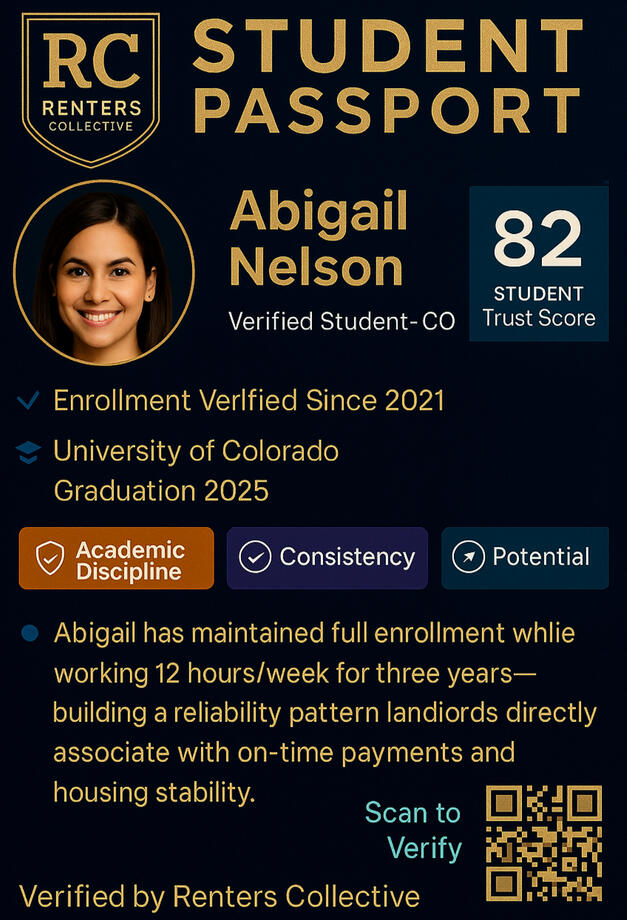
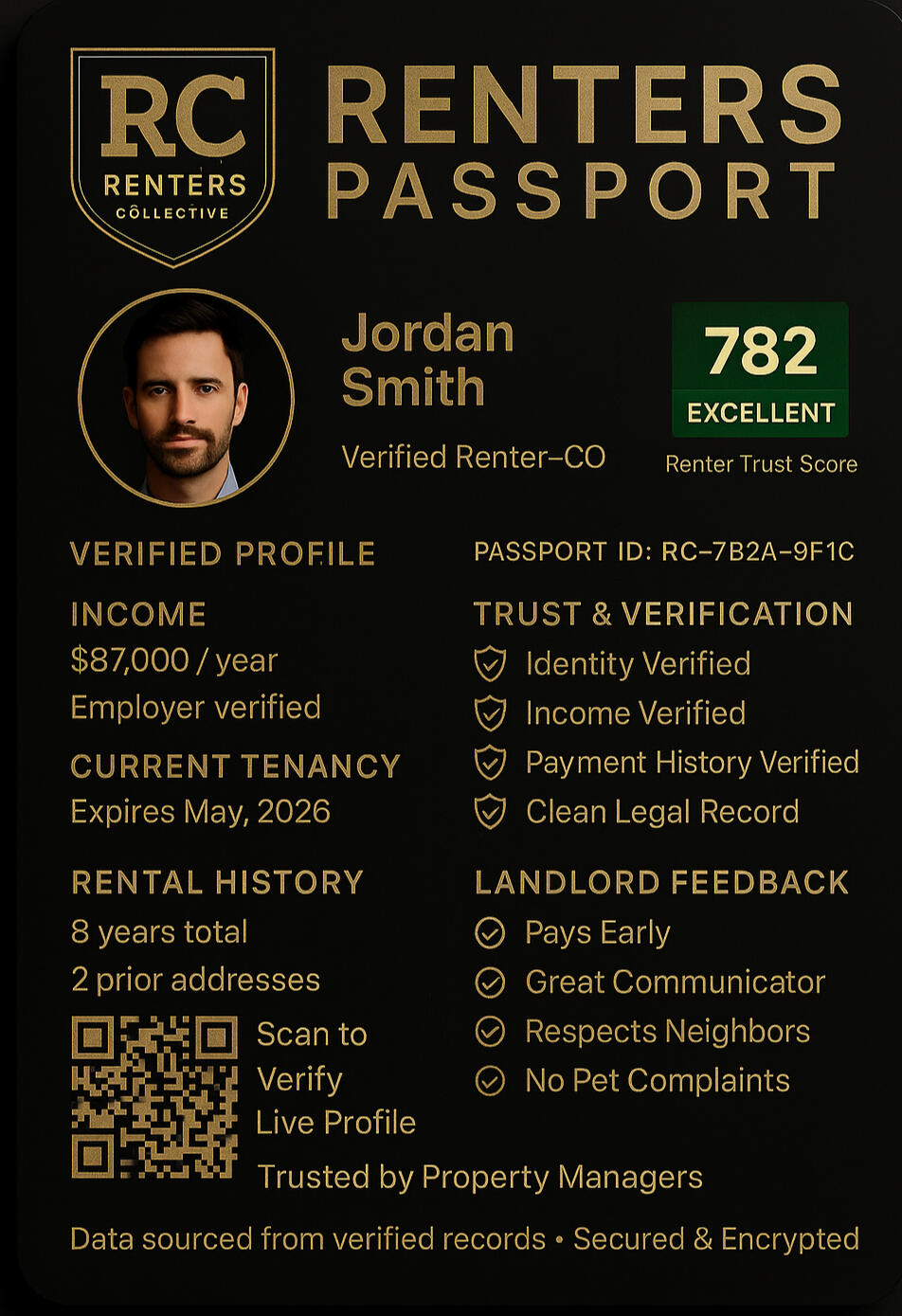
Integrity Note: All evidence artifacts are cryptographically signed, immutable upon issuance, and governed by automated expiration under Protocol §4.7.
Evidence Use
Verified information is provided for rental screening only. These guidelines protect both housing providers and applicants by clearly defining appropriate use.
Permitted Use
Not Permitted
Safeguards
Multiple Properties Under One Manager
Information may be used across properties only when the applicant is actively applying under the same management entity.
Record Retention
Records should be retained only as required for lawful case-file documentation.
Not the Sole Factor
Verified information is one input among many. Final decisions must follow applicable housing law.
Shared Transparency
Applicants receive the same explanation of how their information may be used.
Clear use rules protect everyone involved in the screening process.
How to Screen Applicants
Provide basic property and applicant details. We'll send a secure invitation for verification. The applicant completes verification and covers the fee; you receive standardized results without handling sensitive information.
Use this for individual applicants or to standardize screening across your entire portfolio.
Enter property and applicant details. We'll generate a secure verification request for the applicant to complete.
Start Screening Now → See how we protect your decisions →This starts the standardized verification process following Colorado guidelines.
Every verification request is securely signed, time-stamped, and automatically expires if not completed.
See the Evidence
This sample shows exactly what you’ll receive when reviewing a renter. All information is verified, clearly organized, and presented for quick decision-making.
View Sample Passport →Sample format • Representative view • No applicant data shown
For Property Managers
Manage renter verification across multiple properties using the same clear standards. You get consistent records, centralized review, and audit-ready documentation.
Send verification requests to entire applicant groups at once. Every invitation follows the same process and produces consistent results.
View verified renter information across properties in one place. Maintain clear records for review, comparison, and compliance.
Each verification generates a standardized record. Documentation is consistent across properties and ready when you need it.
Built for multi-property operations that require consistency, clarity, and defensible records.
Verified Roles
We verify who can make decisions and who needs to provide evidence. Your authority is established first, keeping every decision in your hands.
Applicants provide facts. You make decisions.
Applicants provide verified evidence following our consistent rules.
You receive complete, standardized results for clear decision-making.
Your role as decision-maker is verified once and remains established.
We don't score. We don't rank. You decide.
We maintain a registry of verified landlords and property managers. Verification establishes your authority—it never scores or ranks you.
Our principle: We verify authority. Applicants provide facts. You make decisions.
How It Works
You request. They verify. You decide. Get clear results without ever touching sensitive financial data.
Four Simple Steps • Designed for Landlords
Step 1
Send an invitation to the applicant. They complete verification directly—you never see their private financial details.
Step 2
The applicant securely connects their information. If they already have a Passport, they can share it instead.
Step 3
Receive a standardized summary showing what's verified, timelines, and key indicators—ready for your review.
Step 4
Apply your criteria and choose. A clear record is saved for future reference and compliance needs.
Requesting verification is always free. Applicants choose whether to complete and share their information.
Where It's Used
Actively used in rental screening workflows across Colorado.
Based on the most recent 12 months of verified usage
Used in centralized screening workflows across Front Range apartment portfolios for consistent, reliable results.
Trusted for income-restricted housing that requires consistent documentation and clear audit trails.
Used by independent landlords and small property owners who need reliable screening without large management systems.
Usage note: These are verified examples of our system actively used in real rental screenings.
Get Started
Send a verification request to an applicant. They complete the process directly, and you receive a standardized summary to review.
No landlord fees • No document handling • Standardized format
You request verification. The renter chooses whether to complete and share it.
Cost Structure
There is no cost for landlords. Verification is paid for by the renter who chooses to complete it.
You can request verification freely. Renters decide whether to complete and share it.
Why This Works
Traditional screening relies on disconnected tools, manual document review, and inconsistent interpretation. This system replaces that fragmentation with verified information, presented the same way every time.
Every renter is reviewed using the same verification criteria. No property-by-property reinvention. No subjective document parsing.
Identity, income, and rental history are confirmed directly. You review verified results, not uploaded paperwork.
You see verified patterns over time, without scores or predictions. The system provides context — you decide.
Verified information is presented consistently across units and portfolios. Decisions stay comparable, even as operations scale.
You never handle bank statements, IDs, or source documents. Renters share only verified summaries they authorize.
Each review produces a consistent record. Documentation is ready for reference, audits, or compliance checks.
Clear verification and consistent records reduce uncertainty across the leasing process.
This system provides verified information — not scores, predictions, or black-box judgments.
Pricing
Pricing is public, consistent, and the same for every applicant. There are no landlord fees and no hidden charges.
Landlord cost: $0 • Applicants pay verification fees • Same statewide pricing
Pricing is fixed, published, and applied the same way every time.
FAQ
Clear answers about timing, cost, what you see, and how verification fits into your screening process.
These answers describe how the system works in practice.
Documentation
Detailed documentation describing how verification works, how information is handled, and how standards are applied consistently.
How verification is requested and initiated without handling sensitive source data.
How different types of verified information are classified and reviewed.
How stability and affordability signals are derived from verified history.
How privacy safeguards, data limits, and regulatory alignment are handled.
Full documentation is available for transparency and reference.
Support
If you have a question or run into an issue, our team can help. Most requests receive a response within one business day.
You can also email us directly at [email protected]
Support is available for setup questions, verification issues, and general use.
Current Position: Senior Developer (2.5 years, W-2)
Previous Position: Software Engineer (2 years, W-2)
Employment Continuity: No gaps in 4-year employment history
Tenancy Duration: 5+ years cumulative
Current Management: ABC Property Management (confirmed)
Payment Performance: 35/36 on-time payments (97%)
Historical Anomaly: Single 3-day delay in 2023 (bank holiday)
| Duration | Location | Exit Classification | Renewals |
|---|---|---|---|
| 3.1 years | Denver, CO | Lease Completed | 2× Renewals |
| 2.9 years | Boulder, CO | Job Relocation | 1× Renewal |
| 2.3 years | Fort Collins, CO | Lease Completed | 1× Renewal |
Verification Disclosure
Read-only verification profile generated by Renters Collective for rental screening review. Information reflects verified data available at time of issuance and may expire or update. Renters Collective does not approve applicants or replace independent screening.
Verification Disclosure
Read-only verification profile generated by Renters Collective for rental screening review. Information reflects verified data available at time of issuance and may expire or update. Renters Collective does not approve applicants or replace independent screening.
The system executes under defined jurisdictional boundaries. Its function is to govern data flow, produce immutable evidence artifacts, and establish the procedural framework within which the reviewer operates.
The Protocol governs input scope. Only data streams necessary to generate the three primary evidence classes (Identity Attestation, Financial Capacity Attestation, Tenancy History Attestation) are admissible. Source documents are sequestered within the system; reviewers receive only the standardized, immutable attestation output.
The system enforces a tripartite structure: Applicant (Data Principal) → Protocol Executor (System) → Reviewer (Landlord). This creates a verifiable chain of custody. Raw data does not cross the jurisdictional boundary to the reviewer; the system transmits only protocol-defined evidence artifacts, preventing editorialization and constraining interpretation.
The system does not decide. It provides the evidentiary basis for a decision under the reviewer's sole authority. All outputs are formatted as attestations—direct-source verifications that satisfy a specific clause of the pre-qualification standard.
Governance Note: The reviewer's discretion operates within the bounds of applicable law. The system's output standardizes the input to that discretion, creating a defensible, consistent procedural record.
Issued evidence artifacts are cryptographically sealed and immutable for their validity period (standard: 30 days). Post-expiry, they are archived as part of the procedural record but are marked invalid for active review. This governs data relevance and enforces decision currency.
The system assumes liability for the integrity of the verification process and the fidelity of its attestations. The reviewer assumes liability for the final application of those attestations to a selection decision. This boundary is explicitly defined in the system's governing agreement.
Standardized interpretive signals derived from primary evidence classes. These signals constrain subjective analysis by providing governed, comparable evaluation metrics for the reviewer's discretionary application.
Interpretive signals are standardized metadata derived from primary evidence attestations (Identity, Financial Capacity, Tenancy History). They serve as governed evaluation metrics, summarizing patterns without exposing underlying evidentiary materials.
Governance Note: Signals are not decisions, predictions, or automated judgments. They are governed metadata designed to structure—not replace—the reviewer's discretionary authority.
Quantified stability metrics derived from Identity and Tenancy History attestations. Measures housing and employment duration against protocol-defined continuity thresholds.
Standardized ratio analysis derived from Financial Capacity attestations. Calculates income-to-rent alignment without exposing raw financial documents or sensitive data streams.
Pattern indicators derived from Tenancy History attestations. Reflects payment continuity and property care references when available under protocol-admissible parameters.
Interpretive signals are designed to establish consistent evaluation parameters across applicants. They structure the evidentiary input to the reviewer's discretion, which operates under property-specific criteria and applicable jurisdictional law.
Protocol Rule: Signals do not mandate outcomes, rank applicants, or substitute for lawful screening practices. They standardize the input to discretion, not the output of decision.
A governed procedure that enables property reviewers to request evidence attestations without establishing data custody or handling raw evidentiary materials.
The verification sequence is activated when a reviewer issues a governed invitation token to a prospective tenant. The reviewer does not request, receive, or establish custody over evidentiary source materials at any point in the initiation phase.
The applicant submits evidentiary materials directly to the protocol-executing system. The reviewer's jurisdiction is limited to receiving standardized attestation outputs. Raw verification documents remain sequestered within the system's evidentiary boundary, establishing a clear chain of custody.
Upon attestation completion, the system delivers a cryptographically sealed evidence package containing: (1) Verified identity status, (2) Financial capacity ratio analysis, (3) Tenancy continuity metrics, and (4) Standardized interpretive signals derived from the primary evidence classes.
The system assumes liability for the integrity of the verification process and the fidelity of issued attestations. The reviewer assumes liability for the application of those attestations to a tenancy decision. This protocol establishes a clear evidentiary boundary, eliminating data custody obligations and associated compliance exposure for the reviewer.
Renters Collective applies consistent, neutral verification criteria to all applicants. Data is encrypted and never shared as raw documents.
Renters Collective is not a credit bureau or background check provider. Verification signals supplement, but do not replace, landlord screening requirements.
Status: Verified under Protocol 3.1
Verification Method: Government-issued credential with biometric validation
Attestation Date: 2026-01-14
Validity Window: Standard 30-day currency
Status: Verified under Protocol 3.2
Attested Capacity: Supports rent obligations up to approximately $2,300/month under standard ratio analysis
Verification Method: Direct-source financial data connection with employer confirmation
Attestation Date: 2026-01-15
Note: Exact income figures sequestered per data minimization protocol.
Status: Verified under Protocol 3.3
Continuity Period: 8.2 years of verified residential history
Adverse Events: None recorded within protocol-admissible history window
Structured reference tags derived from verification process:
Tags represent pattern indicators, not subjective evaluations.
This dossier constitutes a governed evidence artifact for use in pre-qualification review. It provides the evidentiary basis for decisions under the reviewer's sole discretion, to be applied in accordance with applicable jurisdictional law and property-specific criteria.
Protocol Rule 4.1: This artifact is immutable once issued. It expires automatically after its validity window and may not be used for purposes outside the pre-qualification review for which it was generated.
Participate in a governed pre-qualification standard producing verified decision artifacts for applicant review. All renter submissions are issued as a complete, protocol-bound passport, prior to applications, fees, or discretionary screening.
Observed Protocol Outcomes
Protocol Rule: All renter passports are issued prior to application, remain immutable once generated, and expire automatically under system governance.
Outcomes Issued Under the Renters Collective Protocol
Each outcome below is not a feature, incentive, or promise. It is the direct result of operating within a governed pre-qualification standard that constrains interpretation and standardizes review inputs.
Vacancy loss and payment volatility are reduced through pre-issued, verified eligibility artifacts submitted prior to application.
Identity, income alignment, and tenancy indicators are verified before discretionary screening or fee exposure occurs.
All verification materials are compiled, validated, and issued as a single immutable decision artifact.
Applicants submit complete, review-ready evidence packages, allowing immediate eligibility assessment.
Participation grants access to the statewide Verified Renter Passport standard issued under Renters Collective governance.
All verification artifacts are timestamped, immutable, and preserved as a defensible review record.
Protocol Rule: All outcomes above are emergent properties of governed verification, not discretionary system outputs.
Protocol Operations & Reference Layer
A centralized reference and execution layer governing verification workflows, risk containment procedures, and review standards under the Renters Collective Protocol.
A governed operations library providing standardized workflows, fraud-prevention procedures, compliance references, and portfolio-level review guidance. All materials align directly with the verification artifacts issued by the system.
Protocol Scope: Reference materials inform review; all eligibility decisions remain solely with the landlord.
Operational Efficiency Analysis
Standardized protocol execution eliminates administrative variance, compressing the verification cycle from discretionary days to governed hours.
Protocol execution standardizes the verification timeline, eliminating administrative variance and vacancy cost accrual.
Evidence Artifact Preview
Standardized evidentiary outputs generated under the Renters Collective verification protocol—providing governed evidence for reviewer decisions.

CLASS: Standard Evidence Artifact | PROTOCOL: RC-PQ-01

VARIANT: Student Protocol | SAME EVIDENCE CORE, ROLE-OPTIMIZED FORMAT
Identity Attestation:
Verified under Protocol 3.1 through government credential validation and biometric coherence check.
Financial Capacity Attestation:
Direct-source income verification with standardized ratio analysis under Protocol 3.2.
Payment Continuity Indicators:
Pattern analysis derived from financial attestations within defined confidence thresholds.
Tenancy History Attestation:
Residential continuity verification
No adverse events within protocol-admissible history
Landlord reference patterns analyzed
Pre-Qualification Status:
ELIGIBLE — Meets Protocol Standards for Review
*Artifacts include cryptographic sealing and temporal validity markers.
All artifacts generated under Renters Collective verification protocol standards
External Review Signals
The statements below are not endorsements or guarantees. They represent early reactions from housing providers reviewing protocol-issued verification artifacts during pilot evaluation.
“When applicants arrive with verification already issued, the review process compresses immediately. Document follow-ups become unnecessary.”
— Property Owner, Fort Collins
“Student applications are difficult to interpret under traditional screening. Protocol-verified funding signals resolve that ambiguity.”
— Landlord, Boulder
“Receiving verified identity and income prior to scheduling a tour materially changes the efficiency of leasing operations.”
— Portfolio Manager, Denver Metro
Protocol Note: Statements reflect individual reviewer observations and do not constitute performance guarantees.
External Review Signals
The records below capture qualitative observations from housing providers reviewing protocol-issued verification artifacts during controlled pilot evaluation. They are provided for reference only and do not assert outcomes.
“When applicants present with verification already issued, the review interval compresses immediately and document follow-up cycles are eliminated.”
— Property Owner, Fort Collins
“Student applications introduce ambiguity under conventional screening. Protocol-verified funding signals resolve that uncertainty at intake.”
— Landlord, Boulder
“Receiving verified identity and income artifacts prior to tour scheduling materially alters leasing workflow efficiency.”
— Portfolio Manager, Denver Metro
Protocol Note: Records reflect individual reviewer observations during evaluation and do not constitute guarantees, endorsements, or predictive claims.
Protocol Performance Metrics
Administrative hours eliminated per verification cycle
Protocol efficiency outcome
Protocol execution completion rate
System reliability metric
Verification cycle compression
Time-to-evidence reduction
These metrics represent measured outcomes of protocol adoption versus discretionary verification methods. The 12.8-hour administrative elimination reflects the transfer of verification labor to the governed system. The 97.3% completion rate indicates protocol reliability. The 78–94% cycle compression demonstrates the time efficiency of standardized evidence generation.
Metrics reflect protocol performance, not marketing claims
Protocol Coverage & Applicability
The Renters Collective Protocol applies uniformly across renter profiles. Verification logic adapts to applicant context while preserving consistent evidence standards and review integrity.
Protocol Scope: Applicant classification modifies verification inputs, not evidentiary standards or review thresholds.
Protocol Operation FAQ
Technical specifications and operational parameters of the Renters Collective verification protocol system.
For technical specifications: Consult protocol documentation or contact system administrators
Compliance & Governance Framework
The Renters Collective Protocol constrains data exposure, standardizes eligibility inputs, and supports consistent, defensible applicant review without introducing discretionary system judgment.
Landlords receive protocol-issued verification artifacts rather than raw personal documents. Sensitive applicant data remains isolated within the verification system and is never transferred downstream.
Verification logic is applied uniformly across applicant classes. The protocol removes subjective interpretation by standardizing inputs prior to landlord review.
Each Passport includes a timestamped, non-editable verification trail, providing an auditable reference without requiring landlords to retain or manage sensitive source files.
Detailed implementation notes are published in the Security & Data Protection Specification →
Participate in the Verification Protocol →Protocol Note: The system governs verification integrity; all eligibility determinations remain the sole responsibility of the housing provider.
The Renters Collective Protocol applies uniform verification criteria across all applicants. Verification artifacts are issued as standardized outputs; source documents remain encrypted and are not distributed to housing providers.
Renters Collective is not a credit bureau, consumer reporting agency, or background check provider. Protocol-issued verification artifacts supplement — but do not replace — landlord-controlled screening, underwriting, or decision processes.
Protocol Credential Preview


Standardized credential format v1.0 • Updated 2025 • Governed by the Colorado Verification Protocol
Optional Next Step
Begin renter verificationVerification begins with identity confirmation and produces a standardized credential compatible with this protocol.
Renters Collective operates a standardized renter verification protocol designed to enable pre-qualification review prior to applications or fees.
© 2025 Renters Collective • United States
Verification framework governed under applicable state and federal housing and consumer-protection regulations.
Pricing
Charges apply only when a completed pre-qualification is delivered for review. There are no subscriptions, setup fees, or charges for incomplete attempts.
$29
Applied only when a completed pre-qualification is delivered for review.
$0
Basic pre-qualification access is free. Optional verification services, if available, are clearly optional and selected by the participant.
Pay only when a pre-qualification is delivered · No hidden fees
Charges apply only when a pre-qualification is completed and a review-ready verification is delivered. There are no charges for incomplete attempts, abandoned sessions, or unanswered requests.
Pre-qualification can be initiated at no cost. Any optional verification services are clearly disclosed and explicitly selected by the participant. All screening and decision-making authority remains with the reviewing party.
Protocol Documentation — Landlord Edition
Everything you need to implement consistent, fair screening. We verify the facts, you make the decision—using the same process for every applicant.
Simple process · Verified facts · You decide
The Standardized Process
Simple, consistent verification that puts you in control. We check the facts, you make the decision—every time.
Stop piecing together documents from different sources. We provide a complete, verified package for every applicant so you can focus on choosing the right tenant.
The bottom line: We handle the verification work, you focus on choosing tenants. Same process for every applicant.
Consistent process · Verified facts · You're in control
Before You List
We lock in listing details and eligibility criteria upfront so applicants know where they stand—and you spend less time reviewing mismatched applications.
We require listings to reflect real property conditions, terms, and limits—so applicants apply based on facts, not assumptions.
Why it matters: Clear listings reduce wasted applications and back-and-forth.
You set income requirements, occupancy limits, and policies before applications open—so only qualified renters move forward.
Why it matters: Fewer subjective decisions. Cleaner reviews.
Fake pay stubs and altered documents are common. We eliminate that risk before applications ever reach you.
How: Information comes directly from verified sources—not uploads.
Clear rules · Verified information · Fewer wasted applications
Standardized Process
Stop guessing which documents are real. We verify the key facts, then give you clean, consistent reports so you can make fair, defensible decisions.
No more blurry passport photos or questionable IDs. We verify government-issued identity for every applicant using the same secure process.
We connect directly to bank or payroll systems to confirm income, then show you the numbers clearly. No more guessing if pay stubs are real.
We flag important discrepancies—like employment gaps or conflicting information—so you can focus on what matters without drowning in paperwork.
Fair to applicants · Easy for you · Consistent results every time
Business Tools
Go from landlord to business owner. Keep good tenants longer, handle issues professionally, and grow your portfolio with confidence.
Get help writing professional replies to maintenance requests, lease renewals, and tenant questions in your own voice.
Keep photos, emails, receipts, and inspection notes organized in one place. Be ready if questions or disputes arise.
See occupancy rates, renewal dates, and key metrics across all your properties in one simple view.
Professional tools · Better documentation · Smarter decisions
Move-Out Process
End tenancies professionally, handle security deposits fairly, and get your property rented again quickly.
Use the same checklist and photos every time to document property condition and support any deposit decisions.
Know the difference between normal wear-and-tear and actual damage. Tie every deduction to specific, documented issues.
Start preparing your listing and screening new applicants before the old tenant even moves out.
Professional endings · Fair deposits · Less vacancy
What’s Coming Next
We’re building practical tools on top of verified renter data—designed to save time, surface risk, and support better decisions.
Upload a lease and get a clear summary of key clauses—highlighting unusual terms so you can standardize faster.
See patterns beyond credit alone—payment history, consistency, and verified behavior—presented clearly, without black-box scoring.
Get reminders for changing local requirements and deadlines—so compliance doesn’t require constant monitoring.
Decision support · Time savings · No loss of control
Ready to Begin
Note: The Landlord Help Hub is designed to support your process, not replace legal advice. Always confirm compliance with local laws and regulations in your area.
Institutional workflow · Verified screening · Professional landlord framework
Ready when you are
This hub supports your screening process—it doesn’t replace your judgment or local legal requirements. You stay in control of every decision.
Verified listings · Clear criteria · Fewer wasted applications
Protocol Identifier: CVP-1.0
Release Date: 2026-01-15
Effective Date: 2026-02-01
Status: ACTIVE
Governing Authority: Colorado Housing Statutes
Administrative Authority: Colorado Verification Protocol Governance Board
Technical Authority: Protocol Specification Committee
Supersedes: None (Initial Release)
Next Scheduled Review: 2026-07-01
Classification: PUBLIC
Document Control Identifier: CVP-1.0-20260115
This specification is organized into the following sections:
This protocol applies to all residential rental qualification transactions conducted within Colorado using implementations of the Colorado Verification Protocol. It standardizes:
The Protocol establishes a uniform technical and operational framework for rental applicant verification, replacing fragmented documentation workflows with interoperable verification bundles governed under a formalized rule system.
The Passport is the standardized digital container that stores renter identity and verification references. All implementations shall conform to the Passport requirements defined in this specification.
cvp_[32-character alphanumeric])The Verification Bundle is a structured collection of verified claims about a renter. Implementations shall adhere to the standardized JSON schema defined below.
{
							"bundle_id": "vb_[64-character hash]",
							"passport_id": "cvp_[32-character alphanumeric]",
							"verifications": [],
							"issuance_date": "ISO8601 timestamp",
							"expiration_date": "ISO8601 timestamp",
							"signature": "ECDSA P-384 digital signature"
}The Verification Visibility Model defines which data elements are visible during each Activation State. All implementations shall enforce the minimum necessary disclosure principle.
| Verification Type | Discovery Phase | Application Phase | Post-Acceptance |
|---|---|---|---|
| Identity Summary | Partial | Full | Full |
| Credit Tier | Yes | Yes | No |
| Income Range | Yes | Yes | No |
| Exact Income | No | Yes | No |
Operators shall not:
| Data Type | Retention Period | Post-Period Action |
|---|---|---|
| Accepted Applications | 24 months | Archive (encrypted) |
| Denied Applications | 30 days | Purge (secure deletion) |
| Withdrawn Applications | 7 days | Purge (secure deletion) |
| Audit Logs | 36 months | Archive (immutable) |
| Verification Bundles | 90 days inactive | Purge (secure deletion) |
| Version | Date | Description | Status | Effective Date |
|---|---|---|---|---|
| 1.0 | 2026-01-15 | Initial Release | ACTIVE | 2026-02-01 |
This specification is issued pursuant to authority established under Colorado housing statutes, associated administrative rules, and related state regulatory provisions governing rental housing qualification and verification practices. Implementations of the Colorado Verification Protocol are subject to governance, oversight, and enforcement by the Colorado Verification Protocol Governance Board and other duly authorized state entities.
No implementation may modify, alter, extend, or deviate from the requirements defined in this specification without explicit written approval from the Governance Board. Unauthorized deviations shall be considered non-conforming and may result in suspension, revocation, or additional regulatory action as described in Section 11 (Compliance and Enforcement).
Where conflicts arise between this Protocol Specification and external regulatory requirements, the more stringent requirement shall apply. Implementers are responsible for ensuring ongoing compliance with all applicable Colorado and federal laws.
The governed technical standard for statewide rental verification in Colorado
Publication Version
v1.0.0
Status
ACTIVE
Published
2025-01-15
Effective
2025-02-01
Next Review
2026-01-15
Stability Level: FINAL • First public release • No known errata
The Colorado Verification Protocol is maintained and published by the Colorado Verification Protocol Authority, the governing body responsible for interpreting, updating, and enforcing this standard across the state.
This protocol defines the normative requirements for rental identity and eligibility verification across Colorado, establishing consistency where inconsistent screening practices have historically created inequity, risk, and privacy concerns.
Protocol Objectives
The Colorado Verification Protocol is structured as a layered system, with each layer defined by normative requirements in the Specification.
Protocol Layers & Normative Sections
The Protocol establishes binding requirements that all conformant implementations MUST satisfy.
Conformance Statement
Implementations claiming CVP conformance MUST satisfy all normative requirements defined in Sections 3–13 of the Colorado Verification Protocol Specification.
© 2025 Colorado Verification Protocol Authority
This page is non-normative. The CVP Specification is the sole authoritative source of requirements.
Conformance requires implementation of Sections 3–13.
Protocol Specification • v0.9 Draft • Normative Standard Print Version
The governed, statewide standard for rental identity and eligibility verification in Colorado.
Normative Status Notice
Sections 3–13 define the binding requirements of the Colorado Verification Protocol.
Keywords follow BCP 14 (MUST, MUST NOT, SHOULD, MAY).
The Colorado Verification Protocol standardizes rental identity and eligibility verification statewide.
The Protocol exists to:
Scope Note: The CVP applies to all verification activity within the Colorado Passport system.
A system is conformant if it adheres to Sections 3–13.
Conformant systems MUST maintain audit trails.
The Protocol defines four actors:
Controls credential sharing and consent.
Must follow visibility limits (Section 8).
Performs verification under Section 7.
Maintains and evolves the Protocol.
The Protocol consists of four layers:
Establishes identity before eligibility checks.
Standardizes income, employment, enrollment, etc.
Controls what can be seen and when.
Defines sharing, time limits, and revocation.
Implementation Note: These definitions are normative.
The Protocol defines minimum requirements for each verification category. All verification MUST be completed within 90 days of credential use.
Required Elements
Security Requirement: Identity documents MUST pass authenticity and integrity checks. Suspected forgeries MUST be reported to the governance body.
Standardized Categories
All verifications have explicit validity periods to ensure information remains current:
The Protocol enforces a least-visibility posture. Landlords see only what is necessary, only when permitted, and only for limited durations.
Example: A landlord may see "Tier 2 • Seeking 1BR • Available Aug 1" — no PII, no documents, no contact info.
Security Requirement: Credential transmissions MUST use end-to-end encryption and tamper-evident audit signing.
The Colorado Verification Protocol provides these binding guarantees:
A renter's data is NEVER shared without explicit consent. Renters may revoke access at any time.
All access windows — Discovery, Snapshot, and Application — expire automatically.
All verification and credential access events are recorded in an immutable audit log.
No landlord may access any signal beyond Protocol rules. Discovery State contains ZERO PII. Credential Snapshots contain ONLY signals the renter explicitly consents to share.
The Protocol defines a fixed, transparent fee structure to prevent exploitation.
Prohibition: Housing providers MUST NOT charge renters for Protocol verification. Verification costs are borne by the provider.
The Protocol is governed by an authoritative body with enforcement responsibilities.
The Governance Body is responsible for maintaining, interpreting, and updating the Protocol.
The Protocol establishes clear liability boundaries to protect all participants.
Liability Rule: The party experiencing a data breach is responsible for notification and mitigation costs.
Protocol participants MUST maintain cybersecurity insurance meeting minimum standards.
Protocol changes follow a structured, transparent process with stakeholder input.
Security vulnerabilities or legal requirements may trigger expedited changes with 14-day notice.
The Protocol aligns with globally recognized standards for identity and data protection.
The Protocol establishes mandatory security controls for all systems handling verification data.
Security Rule: PII MUST NOT be stored beyond its validity period. Deletion MUST be cryptographically verifiable.
Conformant implementations MUST demonstrate compliance through verifiable evidence.
The Protocol defines technical interfaces to ensure cross-system compatibility.
Interoperability Rule: Systems MUST accept and produce data in Protocol-defined formats without transformation loss.
This section defines the normative status and administration of this specification.
Publication Date
2025-12-15
Effective Date
2026-01-01
Governing Authority
Colorado Verification Protocol Governance Body
Document Identifier
CVP-SPEC-2025-v1.0.0
Normative References
End of Colorado Verification Protocol Specification
© 2025 Colorado Verification Protocol Authority. This specification is governed by the change management process defined in Section 14.
The governing authority responsible for maintaining, interpreting, and updating the Colorado Verification Protocol.
The Colorado Verification Protocol Authority (CVPA) is the stewardship body responsible for publishing, maintaining, and interpreting the Colorado Verification Protocol (CVP). The CVPA ensures that the Protocol remains consistent, secure, and aligned with Colorado’s rental housing ecosystem.
Protocol modifications follow a structured, transparent lifecycle overseen by the CVPA. The normative rules for protocol updates are defined in Section 14 of the CVP Specification.
Note: The Governance Page is non-normative. Only the CVP Specification contains authoritative requirements.
The CVPA publishes non-sensitive governance materials to promote transparency, including:
Governance inquiries may be submitted via the channels listed on the Protocol Contact page. Formal requests for clarification MUST reference the relevant section(s) of the CVP Specification.
© 2025 Colorado Verification Protocol Authority
This page is non-normative. All authoritative requirements are defined in the CVP Specification.
Governance actions must align with the Protocol’s Change Management Process (Section 14).
Your Colorado Passport reflects how much verified information is available for landlords to review before requesting an application or fee. Most renters begin verified, add additional signals over time, and use priority visibility only when competitive markets require it.
Baseline pre-qualification profile.
Default starting state for most renters.
Additional qualification signals.
Built through additional verification and longer history.
Time-sensitive visibility option.
Used selectively when speed—not qualification—is the constraint.
This is your Renter Identity — a living, standardized record of your rental history, designed to be reviewed by housing providers before applications and fees, rather than recreated from scratch each time you apply.
A living record of verified documentation, identity checks, and rental participation — structured so housing providers can review qualification before applications or fees.
Live • Verification-based
Additional verification can provide clearer context for landlords during early screening.
Housing providers review the same structured renter identity before applications, reducing subjective or inconsistent decisions.
Verified information remains available for review across listings without repeated uploads, explanations, or fees.
Your renter identity remains usable as landlords, locations, and market conditions change.
Your identity becomes more complete as additional records are verified.
How early screening handles limited history →Your renter identity is reviewed as a standardized record before applications or fees — not as a collection of documents, explanations, or subjective claims.
Renters Collective is designing a Maintenance Reliability Signal — a system-level indicator of how consistently housing providers respond to and resolve routine maintenance requests.
This future signal will be derived from aggregated, anonymized patterns of verified renter experiences, collected after tenancy ends. It is designed to reflect operational consistency over time, not to catalog individual incidents.
This signal is not a review system, a complaint board, or a narrative feed. It is a diagnostic pattern indicator, built for fairness and accuracy.
Your renter identity is reviewed in defined stages to support pre-qualification before applications or fees. Nothing personal is shared unless you explicitly allow it.
These signals allow landlords to assess fit early — without accessing personal details.
Shared only after mutual interest is established — not during initial screening.
Providers cannot view, infer, or access activity outside their direct engagement.
A verified, reusable renter identity designed to be reviewed before applications, properties, and fees.

Instead of repeatedly submitting documents, explaining history, or relying on informal references, your Renter Passport functions as a single, authoritative qualification record.
Verification occurs once and remains usable — under your control — whenever housing providers review your profile before requesting an application or fee.
Free to start · Reviewed before applications · Works statewide
Once verified, your renter history remains available for early review — independent of landlords, properties, or time gaps.
Proof of being a reliable renter should not disappear between applications or require re-explanation each time.
Renters Collective preserves verified rental records as protocol-level evidence that housing providers can review before requesting applications or fees. Each record reflects exactly what was verified, when it was verified, and how verification occurred.
Your records persist regardless of property ownership, management changes, or landlord availability — and remain reviewable for future screening.
Each verification includes date, source, and method — enabling consistent early evaluation, not recollection.
Verification occurs once and remains usable whenever landlords assess fit — before applications or fees.
Every verified record in your Passport includes a system-issued verification stamp used during early screening.
Straightforward answers about privacy, control, and how your Renter Passport is reviewed before applications or fees.
No. During pre-qualification, providers see only your verification status, record completeness, and general readiness indicators.
Your identity and documents remain private unless you explicitly approve disclosure.
Only after you approve engagement. Housing providers cannot access your contact details or message you during initial screening.
You choose what information is shared, and only with that specific housing provider.
Approval typically occurs after a landlord confirms you meet their criteria and wishes to proceed.
Yes. You may disable visibility at any time. When disabled, your renter identity is not available for pre-qualification or review.
No. Creating and holding a Renter Passport does not require payment from renters.
Application fees, if requested by a landlord, occur only after pre-qualification — not before.
Verify once. Control what’s shared. Use your renter identity before you apply.
Start Pre-QualificationColorado’s framework defines how renter identity, eligibility signals, privacy boundaries, and data handling are structured before applications or fees.
This is the reference architecture for fee-safe pre-qualification.
How renter eligibility is assembled, interpreted, and reviewed within a standardized framework.
The framework defines how pre-qualification records are created, how eligibility signals are derived from verified inputs, and how those signals are reviewed consistently by housing providers prior to applications or payment. This structure reduces unnecessary fees, limits redundant documentation, and establishes a predictable review order for both renters and operators.
A structured eligibility pathway designed to be reviewed before applications or fees.
Establish your renter record by providing core identity details and required inputs. This forms your pre-qualification foundation and prepares your eligibility signals for review.
Secure checks confirm identity and validate submitted information. Once complete, your pre-qualification status becomes review-ready for housing providers.
Share your pre-qualification record when requested — or proactively. Housing providers can review your eligibility signals before moving you into a full application workflow.
Your Pre-Qualification Passport is a structured renter record — designed to be reviewed before applications or fees. As you complete required steps and strengthen your record, your eligibility signals become clearer and more compelling.
Strong applications start with review-ready identity.
Your Pre-Qualification Passport is not a credit score. It is a review-ready eligibility profile built from verified identity, submitted information, and participation signals. Housing providers use it to understand:
As your information and participation update, your pre-qualification record refreshes automatically. Below is where your eligibility review begins.
When your renter identity is verified before applications, housing providers respond differently — with faster review, lower friction, and access not available to unverified applicants.
VERIFIED STATUS × STANDARDIZED REVIEW = RENTER LEVERAGE
Responsible renters are finally evaluated — and rewarded — correctly.
Verified Status Outcomes
These outcomes activate once your renter identity is verified. They are not upsells or subscriptions — they are a result of early verification and reduced screening friction.
Verified Participation
Verified renters are eligible for monthly credits tied to responsible participation.
Availability varies by market and partner participation.
Move-In Readiness
Verified renters may receive move-in support resources designed to reduce first-month friction.
Transition Support
Guidance for utilities, internet, movers, and local services — organized to save time during relocation.
Savings depend on location and provider availability.
Lease Awareness
A plain-language lease summary to help renters understand key risks and obligations before signing.
Educational guidance only — not legal advice.
Always Included
These tools are standard for every verified renter. They support early review, secure sharing, and controlled disclosure — without tiers, upsells, or unlocks.
Share one verified renter identity for pre-qualification before applications or fees are requested.
A clean, standardized profile generated from verified data — designed for consistent landlord review.
Engage only with authenticated landlords and listings that participate in standardized screening.
Encrypted storage for identity, income, and lease records — shared only with explicit approval.
Plain-language summaries of key clauses and risks to support informed decisions before signing.
Generate clear, professional messages to landlords once mutual interest is established.
Your central guide for making informed rental decisions before you apply or pay — covering scams, deposits, leases, documentation, and renter communication with built-in AI guidance.
System Roadmap
These capabilities expand what verified renters can access before applications or fees — as partnerships and integrations come online.
Select verified listings may include smart home starter equipment where supported by participating properties.
Verified renters may access negotiated pricing with movers, cleaners, storage, and utility partners.
Verified identity may enable access to third-party programs that support reduced or deferred deposits.
Verified renters may receive earlier review access to high-demand listings where enabled.
Availability varies by partner participation and market.
Verification States
As your information is verified and history accumulates, your Passport becomes more complete — giving housing providers clearer signals during pre-qualification.
Your identity and core information have been confirmed. This establishes baseline eligibility for early review.
Additional records improve clarity and reduce uncertainty during screening.
Consistency over time becomes visible as verified history accumulates.
A mature Passport with extensive verified history and high signal confidence.
Verification Signals
Rental screening begins with uncertainty. Verification reduces that uncertainty before applications or fees are requested.
Every new housing provider starts from the same position: they don’t know you. Without verified context, they assume risk and delay decisions.
Verification changes that dynamic. It moves you from unknown risk to clear, reviewable information.
Housing providers quickly assess applicants using signals like these:
No Signal — High Uncertainty
“Who is this? Is this legitimate?”
Verified — Moderate Clarity
“At least this information checks out.”
Consistent History — Low Uncertainty
“This is safe to move forward with.”
Verification doesn’t make housing providers prefer you. It reduces uncertainty — and that’s what moves decisions forward.
Verification Progression
Verification isn’t awarded or unlocked. It deepens naturally as records are confirmed and history accumulates — improving clarity during pre-qualification.
What’s confirmed: Identity and core renter profile.
Effect: Eligible for early review instead of blind applications.
What’s added: Income ranges, rental history, references.
Effect: Clearer qualification signals during screening.
What accumulates: Time-weighted, verified rental behavior.
Effect: Reduced follow-up and faster early decisions.
What’s established: Long-term consistency with minimal uncertainty.
Effect: Highest clarity during pre-qualification.
Verification deepens with use — no tiers to buy.
Verification Engine
This is the system that reduces uncertainty, controls visibility, and enables pre-qualification before fees.
Stop starting over. Verified information carries forward so each review begins with context — not guesswork.
Your Passport presents layered signals that landlords use to assess fit before applications or payment.
Identity checks and fraud controls establish baseline legitimacy.
Verified income and rental records reduce uncertainty during screening.
Longitudinal signals show reliability beyond a single application.
Only review-appropriate data is visible until you approve disclosure.
Clear signals allow landlords to decide sooner, without payment pressure.
Landlords see only what enables early review — nothing that compromises privacy.
Review clarity without personal exposure.
You verify → review becomes possible → visibility activates → decisions happen earlier
Fees follow decisions — not the other way around.
Verification enables early review. Nothing is shared without approval.
Discovery Controls
Visibility is never automatic. You decide when, how, and to whom your Passport is reviewable for pre-qualification.
Visibility isn’t exposure — it’s controlled review.
Choose how housing providers can review your verification signals. Nothing identifiable is shared without approval.
Your Passport is not visible. Use this while building or updating records.
Landlords can see verification status and completeness — no name, photo, or identifiers.
Approved landlords may review your profile and request documents after initial fit is established.
Housing providers see only what supports early review — nothing sensitive or irreversible.
Clarity without exposure.
Private → Pre-Qualification → Profile Review → Application
You control the pace. Fees follow decisions.
Visibility supports review — nothing is shared automatically.
Review Outcomes
Verification does not create prestige. It reduces uncertainty — and that produces measurable improvements in how quickly and confidently housing providers can decide.
Clarity changes outcomes.
As verification depth increases, screening friction decreases. These effects build naturally over time.
What changes: Identity uncertainty is removed.
What changes: Qualification becomes clearer.
What changes: Risk perception drops further.
What changes: Review becomes efficient.
Verification improves outcomes across multiple decision points — without changing screening standards.
Landlords can decide sooner when uncertainty is reduced.
Fewer uploads, explanations, and follow-ups.
Fees are requested later, after fit is clearer.
Each move benefits from accumulated verified context.
Verification reduces uncertainty → review happens earlier → fees come later
That is the system effect.
Verification depth increases naturally over time.
Review Process
Renters Collective changes the order of operations. Review happens first. Applications happen later.
Landlords review your verified Passport signals before requesting an application or fee.
Renters Collective presents verified information in a consistent, trusted format for early decision-making.
Only after interest is confirmed does a landlord request a formal application.
Application fees are requested only when a landlord is prepared to move forward.
Only review-appropriate signals — nothing sensitive or irreversible.
Uncertainty is removed early. Decisions happen sooner. Money moves later.
Applications come after review — not before.
Safety & Protection
Your identity, documents, and review activity are protected at every stage inside Renters Collective.
Your Passport shares only review-appropriate identity signals until you explicitly approve disclosure.
Sensitive files remain encrypted and inaccessible until you choose to share them for review.
Renters Collective verifies housing providers, blocks scams, and standardizes early review — before applications or fees.
Verified communication, reduced ghosting, and fraud-resistant interactions.
Even approved housing providers never see certain protected information.
A secure pathway that protects your identity and controls access throughout the rental process.
Verify → Review → Apply → Approve → Revoke Access Anytime
You remain in control of what is reviewed and what stays private.
The Renters Collective Protocol
The formal rules governing identity, visibility, review, applications, and security across Renters Collective.
Our concierge team provides clear, direct answers — no scripts, no sales pressure.
Contact Concierge →Begin Verification
Create a verified renter identity that allows housing providers to review you before applications or fees.
Confirm your identity once using secure verification.
Allow landlords to assess fit using verified signals — without exposing personal details.
Proceed with applications and fees only after interest is confirmed.
Takes about two minutes. Nothing is shared without approval.
Whether you’re just starting your search or reviewing a lease, this hub provides clear steps, trusted explanations, and practical tools to help you make informed decisions before applications or fees.
Renting shouldn’t feel risky or confusing. This toolkit gives you clear steps, practical guidance, and built-in AI helpers to support smart decisions before you apply, commit, or pay.
Reduce risk by spotting scams, confirming legitimacy, and knowing the warning signs before you message a landlord, apply, or send money.
Listings priced far below market are common bait. Never send money or documents before a live video tour or verified showing.
Pro tip: If it feels rushed, pause — urgency is a red flag.
Cross-check the address across platforms and public records. Request a live walkthrough — not pre-recorded clips.
Pro tip: Legit landlords verify themselves.
Ask for proof of ownership or management authority. If they can’t provide it, disengage immediately.
Pro tip: Pressure is the clearest scam signal.
Confirm terms, promises, and documentation before you commit to a lease or assume financial responsibility.
Review clauses covering renewals, termination fees, subletting, repairs, and responsibilities so expectations are clear upfront.
Pro tip: If a clause can’t be explained plainly, pause before signing.
Any promise — repairs, pet approval, parking, utilities — should appear in writing before you sign the lease.
Pro tip: Email a summary to create a timestamped record.
Record a slow, narrated video of every room within 24 hours of move-in to preserve an objective record of the property’s condition.
Pro tip: This is your strongest protection against unfair deposit disputes.
Protect yourself throughout the lease by keeping clear records, documenting issues properly, and maintaining a clean communication trail that supports you later if questions or disputes arise.
Use email for all requests and notices. State the issue, when it began, and the action requested so everything is clearly documented.
Pro tip: BCC yourself to preserve a time-stamped record.
Follow the “Photo + Email” rule: take a clear photo, then send a short email documenting the issue and date.
Pro tip: For urgent repairs, email first, then follow with a polite call.
Create a dedicated folder for every landlord communication — messages, photos, and responses — so evidence is easy to retrieve later.
Pro tip: Your archive is your strongest protection if disagreements arise.
Protect your deposit and close out your tenancy cleanly by preserving clear evidence and documented communication after you leave.
Recreate your move-in video after cleaning to clearly show the home’s condition at move-out.
Pro tip: Capture floors, walls, appliances, and bathrooms in slow, steady pans.
Address small issues like nail holes and basic cleaning, but avoid repainting or major repairs unless you caused damage.
Pro tip: Normal wear-and-tear is not deductible.
Email your forwarding address on move-out day and keep a copy — this establishes a clear timeline for deposit return.
Pro tip: Save the sent email as time-stamped proof.
A decision-support tool designed to help you understand lease terms before you sign or commit to a rental.
This tool will scan your lease and highlight key clauses — fees, deposits, renewal terms, responsibilities, and risks — translated into plain English to support informed decisions.
Informational guidance only. Not legal advice.
A communication support tool designed to help you write clear, professional messages that create a reliable paper trail before issues escalate.
This assistant will draft clear, polite, and well-structured messages based on your situation — maintenance requests, follow-ups, notices, and negotiations — helping you document communication consistently and professionally.
Informational assistance only. Messages remain fully editable before sending.
Note: AI Lease Check and the Message Assistant are decision-support tools available to verified renters. Guidance in the Renter Help Hub is educational and not legal advice. For complex situations, consult local laws or a qualified professional.
Renters Collective provides a standardized pre-qualification framework designed to improve clarity, reduce redundant paperwork, and enable review before applications or fees.
Pre-qualification does not guarantee approval or housing placement. All screening, selection, and leasing decisions remain independent and outside the control of Renters Collective.
Request renter verification through a secure, standardized process. No subscriptions. No upfront costs. You’re charged only when a completed verification is delivered to you.
Send a verification request or review an existing Renters Collective Passport. The renter completes verification independently and securely.
Receive standardized verification outcomes — not raw documents. You never handle sensitive data. No subjective interpretation.
A $29 verification fee is applied only when a verification is completed and delivered. No subscriptions. No minimums. No charge if the verification isn’t completed.
Opens a secure verification request form in a new tab. You’re charged only after successful verification.
Colorado’s verification architecture establishes the formal structure through which identity, eligibility, and compliance data are standardized and evaluated to ensure predictable outcomes statewide.
The Identity Layer establishes a unified, verified renter identity recognized across all participating systems, allowing eligibility to be evaluated without exposing the renter’s underlying personal or financial data.
The Discovery Engine enables landlord-initiated visibility based on verification tier and timing, allowing qualified renters to be identified before they begin searching.
Your information stays yours — abstracted, encrypted, and controlled so landlords see eligibility only, never your details.
The RC-2 layer governs protocol versioning, update integrity, and interoperability, ensuring the statewide standard evolves without compromising consistency or trust.
The Eligibility Standards Engine defines statewide requirements for financial and identity validation, ensuring landlords interpret verification tiers uniformly without requiring access to underlying documents or personal data.
The Compliance Layer defines operational requirements for landlords and integrated systems interacting with the protocol, ensuring statewide consistency, correct use of verification signals, and alignment with Colorado's housing and privacy statutes.
The Audit & Monitoring System governs logging, review, and escalation, ensuring protocol activity remains accountable and consistently applied.
The Integration & API Layer defines secure communication between the protocol and external systems, enabling property platforms and institutions to consume verification signals without accessing underlying personal data.
The Implementation & Adoption Model outlines statewide onboarding flows, participation requirements, and phased rollout strategies ensuring consistent, equitable integration of the protocol across Colorado’s rental ecosystem.
This completes the formal documentation of the Colorado Verification Protocol’s core system architecture. For governance, implementation details, and compliance requirements, continue to the official Protocol Specification.


This section explains how your Passport is built, what Discovery State actually does, what your FIT score measures, and what landlords can — and cannot — see.
Discovery State is a controlled mode renters activate when they want to be discoverable for matching rentals — without exposing identity or documents.
The Passport is a structured set of verified signals — not documents. Landlords see secure protocol signals, not raw files or sensitive data.
The FIT score is a private protocol signal summarizing how well you align with typical landlord requirements. It is not a credit score and is never shared outside the protocol or used to deny you access. It exists only to match you more efficiently with properties that fit your verified profile.

Built for renters with good income, inconsistent credit, or non-traditional histories. Renters Collective organizes what actually matters into a standardized format that makes landlords’ jobs easier.
Landlords typically look for income at 2.5–3× monthly rent. Stability and consistency matter more than raw numbers.
Current and previous addresses demonstrate reliability. Consistency beats perfection.
Job changes are normal. Time at your current role signals predictability.
Matching information across documents builds immediate trust with landlords.
Only the information you approve is shown. No hidden screenings.
Explain gaps or changes so you’re not reduced to a score.
Build once. Use everywhere. Update when needed.
Designed for gig workers, students, and non-traditional paths.
A renter-provided, standardized pre-screening summary designed to reduce document chaos and accelerate initial applicant review — prior to any formal application or screening process.
Renters Collective provides standardized applicant summaries for early review. Final screening decisions remain entirely with the property owner or manager.
This is an applicant-provided summary consolidating income, payment history, and tenancy information into a single format.
This format presents screening information once, prior to a formal application.
This summary does not replace background checks, credit screening, or completed applications.
A standardized pre-screening summary—provided by the applicant—designed to reduce document noise and accelerate early-stage review. Used prior to formal application.
Renters Collective provides standardized applicant summaries to reduce administrative friction during early review. All final screening decisions remain the responsibility of the property owner or manager.
This renter profile has been reviewed and confirmed through Renters Collective's verification process.
One verified renter profile landlords review before applications or fees. Verify once. Reuse everywhere.
Get Your Free Renter Passport →Colorado Verification Protocol
A unified, privacy-first verification framework that regulates how identity, income, and eligibility are validated and exchanged across Colorado’s rental ecosystem.
The Colorado Verification Protocol (CVP) is a statewide standard for how identity, income, and eligibility are verified and communicated. It establishes a consistent, privacy-preserving framework used by renters, landlords, universities, and platforms across Colorado.
Identity
Identity is verified through ID validation, biometric match, and fraud screening — while keeping all sensitive details hidden from landlords.
Eligibility
Verified income is translated into clear E-Tiers (1–4), eliminating subjective screening and ensuring consistent qualification standards.
Privacy
Landlords never see personal identifiers, financial documents, employer names, or income amounts. Only abstracted verification outputs are shared.
Compliance
Landlords and platforms must follow uniform protocol-aligned behaviors, ensuring fairness, privacy, and legal compliance statewide.
The normative rules governing identity verification, eligibility scoring, privacy, and system interoperability — published as Version 1.0 of the CVP.
View Specification →The CVP Technical Standards Working Group maintains the protocol, oversees compliance, and ensures alignment with Colorado legal and privacy frameworks.
View Governance →Universities, software platforms, and housing authorities integrate the CVP using a secure API that transmits only abstracted verification outputs — never raw documents.
See Integration Standards →Every protocol update — from minor clarifications to major eligibility changes — follows a structured governance process with published timelines and deprecation cycles.
View Changelog →Understand eligibility tiers, visibility rules, and the expectations for protocol-aligned screening.
Learn how identity, income, and eligibility are verified privately — and what information remains hidden from landlords.
Integrate with the CVP through standardized APIs, receive abstracted verification outputs, and align with interoperability expectations.
Colorado Verification Protocol
The authoritative technical and operational standard governing identity verification, eligibility tiering, data governance, permissions, compliance, and platform integration within the Colorado Verification Protocol.
This document is the normative specification for the Colorado Verification Protocol. It defines the technical, operational, and compliance rules governing identity assertion, financial eligibility standardization, data governance, and system integration.
Release Candidate 1This document establishes the Colorado Verification Protocol (CVP), a standardized framework for verifying identity and financial eligibility in residential tenancy applications. Its scope is explicitly defined in Section 8.
Sections are ordered to provide a logical flow from foundational definitions to implementation details. Within this document:
The keywords MUST, MUST NOT, REQUIRED, SHALL, SHALL NOT, SHOULD, SHOULD NOT, RECOMMENDED, MAY, and OPTIONAL in this document are to be interpreted as described in RFC 2119.
active/inactive) that determines if a Renter's anonymized profile is visible to Landlords for the purpose of receiving Invitations.The CVP defines two distinct assurance levels to align with national standards:
The CVP is designed to mitigate the following primary threats:
| Threat Vector | Primary Mitigation | Residual Risk |
|---|---|---|
| Fake ID Submission | Biometric liveness check + cross-database screening | Low (Theoretical bypass) |
| Data Interception | TLS 1.3+, signed JWTs, short token lifetimes | Negligible |
| Consent Bypass | Cryptographic binding of Access Token to Renter session | None |
| Platform Data Hoarding | No-local-storage mandate, streaming API only | Managed via compliance audit |
jti (JWT ID) claim to prevent replay and MUST expire 30 days from issuance.To establish a Verified Identity, the system MUST perform and pass the following multi-factor process:
This document is the normative specification for the Colorado Verification Protocol. It defines the technical, operational, and compliance rules governing identity assertion, financial eligibility standardization, data governance, and system integration.
Release Candidate 1This document establishes the Colorado Verification Protocol (CVP), a standardized framework for verifying identity and financial eligibility in residential tenancy applications.
Sections are ordered to provide a logical flow from foundational definitions to implementation details:
The keywords MUST, MUST NOT, REQUIRED, SHALL, SHALL NOT, SHOULD, SHOULD NOT, RECOMMENDED, MAY, and OPTIONAL in this document are to be interpreted as described in RFC 2119.
active/inactive)The CVP defines two distinct assurance levels to align with national standards:
jti claim and MUST expire 30 days from issuanceTo establish a Verified Identity, the system MUST perform and pass the following multi-factor process:
The protocol SHALL NOT expose raw identity documents, biometric samples, or personal identifiers. It outputs only abstracted fields:
identity_status: verified | not_verifiedverification_token: cryptographic proof of verificationname_match_flag: confirmed | not_confirmedfraud_risk_indicator: clear | elevated | rejectedIf verification fails, the CVP returns a standardized failure state:
The CVP provides a standardized, objective method for evaluating rental affordability. Eligibility Tiers eliminate subjective screening by mapping verified income to a transparent, consistent classification model.
Verified Monthly Income is derived from trusted, authenticated sources:
A renter's Eligibility Tier is based on the ratio of Verified Monthly Income to Monthly Rent:
Ratios SHALL be rounded to one decimal place using standard rounding. No discretionary changes are permitted.
Renters MAY provide additional non-essential indicators:
Colorado Verification Protocol
The Colorado Verification Protocol (CVP) defines how identity, income, and eligibility are verified, abstracted, and shared between renters, landlords, and platforms. This page is the entry point into that system.
For technical partners, policymakers, and institutions, the full formal specification is published as a standalone document and governs all protocol behavior.
CVP is a formal standard for rental verification in Colorado. It defines:
Identity
How a renter’s identity is proofed using government ID, biometrics, fraud checks, and residency attestation – without ever exposing raw ID data to landlords.
Eligibility
A deterministic E-Tier model that converts verified income into clear thresholds (E1–E4), reducing subjective judgment and making criteria consistent across landlords.
Privacy
Strict rules for what landlords can see (statuses and tiers) and what they can never see (PII, documents, accounts, employers, amounts).
Compliance
Behavioral and technical requirements for landlords and platforms that want to call themselves “Protocol-Aligned,” including enforcement and sanctions.
The binding rules for identity, eligibility, data governance, and integration are published as a formal specification (Version 1.0).
View Specification →The CVP Technical Standards Working Group is the governing authority, defining versioning, enforcement, and canonical interpretation.
View Governance Model →Property management systems, university portals, and housing authorities integrate via a standardized API, consuming abstracted outputs only.
See Integration Standards →Changes to the protocol follow a transparent process with notice periods, deprecation windows, and documented releases.
View Changelog →To understand what you can and can’t see, how to apply E-Tiers consistently, and what it means to be Protocol-Aligned.
To understand how your identity and income are verified, what remains private, and how Discovery State and Invitations work.
To integrate the protocol into existing systems, rely on it for compliance, and align internal workflows to a statewide standard.
Protocol Documents
Colorado Verification Protocol
This document is the normative specification for the Colorado Verification Protocol (CVP). It defines the technical, operational, and compliance rules governing identity assertion, financial eligibility standardization, data governance, and system integration.
Status: Release Candidate 1 • Governance Authority: CVP Technical Standards Working Group
Normative sections are binding. Examples in Appendix A are informative only.
This document establishes the Colorado Verification Protocol (CVP), a standardized framework for verifying identity and financial eligibility in residential tenancy applications. Its scope is explicitly defined in Section 9.
The keywords MUST, MUST NOT, REQUIRED, SHALL, SHALL NOT, SHOULD, SHOULD NOT, RECOMMENDED, MAY, and OPTIONAL in this document are to be interpreted as described in RFC 2119.
active/inactive) that determines if a Renter’s anonymized profile is visible to Landlords for the purpose of receiving Invitations.The CVP is designed to mitigate the following primary threats:
| Threat Vector | Primary Mitigation | Residual Risk |
|---|---|---|
| Fake ID Submission | Biometric liveness check + cross-database screening | Low (theoretical bypass) |
| Data Interception | TLS 1.3+, signed JWTs, short token lifetimes | Negligible |
| Consent Bypass | Cryptographic binding of Access Token to Renter session | None |
| Platform Data Hoarding | No-local-storage mandate, streaming API only | Managed via compliance audit |
jti (JWT ID) claim to prevent replay and MUST expire 30 days from issuance.To establish a Verified Identity, the system MUST perform and pass the following multi-factor process:
The protocol SHALL NOT reveal raw identity data. Output MUST be limited to:
identity_status: (verified | not_verified)verification_token: A JWT conforming to Section 3.4.name_match_flag: (confirmed | not_confirmed)fraud_risk_indicator: (clear | elevated | rejected)The verification process MAY r
Colorado Verification Protocol
This page describes how the Colorado Verification Protocol is governed, who is responsible for its evolution, and how authority is constrained and made accountable.
Colorado Verification Protocol
A chronological record of changes to the Colorado Verification Protocol specification, including breaking changes, clarifications, and security updates.
Version
Effective Date: [Date of Ratification]
Colorado Verification Protocol
The CVP Technical Standards Working Group is the independent governing body responsible for protocol maintenance, enforcement, and canonical interpretation of all provisions.
The Working Group maintains neutrality and independence. It oversees updates, approves integrations, reviews compliance violations, and ensures alignment with Colorado laws and privacy protections.
Colorado Verification Protocol
This page records all updates to the Colorado Verification Protocol Specification, including breaking changes, clarifications, and security updates.
Version
Effective Date: [Date of Ratification]
This is your gateway from applications and uncertainty to a governed identity inside the Colorado Verification Protocol. Once enrolled, your verified credentials become leverage—giving you visibility and invitations on your terms.
You create your identity inside the Colorado Verification Protocol — a secure record that lets you decide when and how landlords see who you are.
Your submitted information and documents become verification credentials that determine your Passport Tier — without exposing raw documents to landlords.
You receive the controls that govern visibility, invitations, and identity reveal events — always on a landlord-specific basis.
Start your enrollment into the Colorado Verification Protocol. Free for all Colorado renters. Statewide recognition. Privacy by design.
Begin EnrollmentProtocol Guarantee: Your identity remains hidden until you explicitly authorize a reveal. Documents are never auto-shared. Visibility always remains under your control and is landlord-specific.
A unified, privacy-first verification framework that regulates how identity, income, and eligibility are validated and exchanged across Colorado’s rental ecosystem.
The public framework governing verification, eligibility signaling, discovery, engagement boundaries, privacy controls, and participant protections within Colorado’s rental ecosystem.
Navigate The Core Components Of The Colorado Verification Protocol.
Why Colorado Requires A Standardized Verification Protocol.
The Protocol’s Foundational Principles & Structural Layers.
Tiers, Eligibility Signals, And The Verification Passport.
Discovery States, Visibility Matrix, And Invitation Rules.
Safeguards, Boundaries, And Anti-Fraud Controls.
System Efficiency, Stability, And Improvements.
Oversight, Working Groups, And Compliance.
Sustainability, Incentives, And Network Effects.
Colorado Statutory And Regulatory Integration.
What The Protocol Does And Does Not Govern.
Why The Protocol Is Not A Screening Service.
Enrollment Paths For Renters And Landlords.
The Systemic Failure Of Traditional Rental Processes And The Mandate For A Statewide Verification Standard.
Every landlord uses different criteria, forcing renters to repeatedly re-prove identity and eligibility.
Renters repeatedly submit sensitive documents to unverified entities, increasing identity theft risk.
Landlords receive a high volume of inconsistent applications with unverifiable claims.
Without A Unified Verification Layer, The Market Suffers From Asymmetric Information, Leading To Inefficient Decisions And Greater Risk.
Housing Lacks A Consistent Identity & Verification Framework — Unlike Finance Or Employment — Leaving The Market Dependent On Unregulated Practices.
Result: High Costs, Delays, Vulnerability To Fraud, And Market Inefficiency.
The Colorado Verification Protocol Establishes A Governed, Privacy-Preserving Standard For Identity Verification, Eligibility Signaling, And Controlled Engagement.
Outcome: Consistency, Security, Privacy Enforcement, And Structured Engagement.
The Structural Framework That Governs How Identity, Verification, Visibility, And Engagement Operate Across The Colorado Rental Ecosystem.
The Protocol Operates As A Five-Layer Governance And Verification System Designed To Ensure Consistency, Privacy, Security, And Standardization Across All Rental Interactions In Colorado.
Renters Retain Full Control Over When And How Identity Information Is Revealed.
Only Eligibility Outcomes Are Revealed — Never Raw Documents Or Sensitive Data.
Both Renters And Landlords Must Be Verified Before Any Engagement Can Occur.
Access To Data Follows Strict Visibility Rules Designed To Reduce Bias.
A Single Verification Standard Reduces Friction And Increases Clarity Across The Market.
The Colorado Verification Protocol Is Composed Of Five Interlocking Layers That Define Identity, Verification, Discovery, Engagement, And Governance Rules.
The Protocol Is Designed To Integrate With Modern Identity And Verification Standards:
How The Protocol Standardizes Identity, Eligibility, And Credentialing Through Reusable Verification Tiers And A Privacy-Preserving Passport System.
Verification Converts A Renter’s Identity And Eligibility Attributes Into A Standardized, Reusable Credential That Landlords Can Trust — Eliminating Repetitive Document Uploads, Reducing Fraud, And Establishing A Consistent Baseline For Decision-Making.
Basic Identity Claimed. Minimal Participation; Not Eligible For Discovery.
Legal Identity Verified. Grants Limited Discovery Access And Invitation Eligibility.
Income, Employment, And Rental History Verified. Enables Full Discovery Participation.
Identity, Eligibility, And Supplemental Proofs Verified. Produces The Strongest Eligibility Signal.
Eligibility Signals Communicate Verified Outcomes Without Revealing Sensitive Documents. Examples:
After Completing Verification, Renters Receive A Passport — A Reusable Credential That Indicates Tier Level, Eligibility Signals, Discovery Permissions, And Engagement Status — Without The Need For Repeated Document Uploads.
By Transforming Sensitive Identity And Eligibility Data Into Reusable, Non-Identifying Signals, The Protocol Reduces Friction, Lowers Screening Costs, Decreases Fraud, And Creates A More Fair, Efficient, And Predictable Rental Market Across Colorado.
The Governed Layer That Regulates How Verified Renters Become Discoverable, What Landlords Can See, And How Engagement Progresses Under Protocol Rules.
Discovery Is The Protocol’s Privacy-Preserving Visibility Mechanism. When Enabled, Renters Broadcast Only Non-Identifying Eligibility Signals To Verified Landlords. No Personal Information Is Revealed Until The Renter Chooses To Engage.
The Protocol Dictates What Is Visible At Each Stage. Visibility Never Expands Automatically — Only Through Renter Consent And State Transitions.
Renters Move Through Four Governed States. Each State Has Defined Visibility Rules And Allowed Actions.
Renter Not Discoverable. No Signals Broadcast. No Engagement Allowed.
Non-Identifying Eligibility Signals Broadcast To Verified Landlords.
A Verified Landlord Has Sent A Protocol Invitation. Renter May Accept Or Decline. No New Visibility Unlocks.
Renter Has Accepted. Identity, Eligibility Outcomes, And Passport Details Are Now Visible Within Protocol Limits.
Invitations Are The Controlled Engagement Mechanism Of The Protocol. They Allow Landlords To Reach Out Without Bypassing Renter Privacy Or Data Boundaries.
Sensitive Information Never Moves Without Explicit Renter Consent. Access Expands Only According To Protocol Rules And Only When Required For Evaluation.
The Mandatory Safeguards The Protocol Enforces To Protect Renters, Ensure Fairness, Prevent Abuse, And Maintain System Integrity Across Colorado’s Rental Market.
The Protocol Establishes Firm, Non-Negotiable Boundaries Around What Data May Ever Be Shared, Viewed, Or Requested — Ensuring Maximum Privacy By Design.
Visibility Is Never Arbitrary — It Is Defined Explicitly By Protocol Rules. Information Reveals Only When Allowed By State And Consent.
The Protocol Reduces Bias By Restricting Access To Non-Relevant Data And Standardizing The Engagement Pathway.
The Protocol Implements Industry-Grade Safeguards To Detect, Prevent, And Neutralize Fraud While Ensuring That Only Authorized, Verified Participants Gain Access To Sensitive Stages.
How The Protocol Reduces Friction, Lowers Costs, Increases Efficiency, And Strengthens Colorado’s Rental Market Through Standardization And Trusted Verification.
Traditional Screening Forces Renters To Repeatedly Submit Documents And Identity Proofs For Each Property. The Protocol Eliminates This Redundancy By Converting Proof Into A Reusable Verification Passport.
Discovery Provides Landlords With Early Visibility Into Verified Renter Demand, Allowing Faster Matching And Reducing Vacancy Duration Across The Market.
The Protocol’s Verification And Eligibility Layers Virtually Eliminate The Most Common Fraud Vectors In Tenant Screening — Saving Time, Money, And Risk.
By Standardizing Verification, The Protocol Creates Predictable Workflows, Increases Trust, Strengthens Market Transparency, And Enhances Efficiency Across Colorado’s Entire Housing Ecosystem.
The Institutional Framework That Maintains The Protocol’s Integrity, Neutrality, Security, And Fairness Across Colorado’s Rental Ecosystem.
The Protocol Is Overseen By A Governance Body Responsible For Maintaining Rules, Ensuring Neutrality, Upholding Participant Protections, And Guaranteeing That The System Cannot Be Influenced For Private Gain.
The Technical Working Group Maintains The Protocol’s Architecture, Verification Logic, Security Standards, And State Machine Behavior — Ensuring Predictability And Integrity.
All Participants Must Follow Protocol Rules. Compliance Ensures A Safe, Fair, And Fraud-Resistant Market For Renters, Landlords, And Property Managers.
Governance Includes Monitoring Market Outcomes (Never Individual Data), Ensuring That The Protocol Continues To Improve Market Stability, Fairness, And Efficiency Over Time.
The Economic Logic That Makes The Protocol Sustainable, Efficient, And Structurally Superior To Traditional Screening Models — Benefiting Renters, Landlords, Property Managers, And Colorado’s Housing Market As A Whole.
Unlike Traditional Screening — Where Renters Repeatedly Pay And Submit Documents — The Protocol Converts Verification Into A Reusable Credential That Can Be Used Across The Entire Market.
The Protocol Aligns Incentives For All Stakeholders, Ensuring That Each Group Benefits From Standardization Without Sacrificing Fairness Or Privacy.
The Protocol Is Designed For Long-Term Stability, With A Cost Structure Based On Verified Participation Rather Than Per-Application Fees — Reducing Barriers For Renters.
As More Renters And Landlords Join The Protocol, Market Efficiency Increases Non-Linearly — Creating A Network Effect That Strengthens Screening, Matching, And Trust System-Wide.
How The Colorado Verification Protocol Aligns With State Housing Laws, Fair Housing Regulations, Consumer Privacy Standards, And Required Governance Oversight.
The Protocol Operates Within The Boundaries Of Colorado Landlord-Tenant Law, Ensuring That All Verification, Screening, And Engagement Processes Comply With State Requirements.
The Protocol Follows A Data-Minimization Philosophy Consistent With Colorado Privacy Law. Personal Data Movement Is Strictly Limited, Controlled, And Transparent To The Renter.
The Protocol Removes Common Bias Vectors By Preventing Access To Any Data That Could Be Used — Intentionally Or Unintentionally — For Discrimination.
Governance Ensures Continuous Legal Alignment, Monitors Market-Level Outcomes (Never Individual Data), And Enforces Protocol Rules Without Favor Or Bias.
What The Protocol Does — And Does Not — Govern. These Boundaries Protect Participants, Prevent Overreach, And Clarify The Protocol’s Scope Within Colorado’s Rental Market.
To Maintain Privacy, Reduce Bias, And Prevent Overreach, The Protocol Explicitly Avoids Verifying Certain Information — Even When Landlords May Be Accustomed To Requesting It.
The Protocol Establishes A Verification And Engagement Layer — It Does Not Replace The Responsibilities And Decisions Required In Rental Transactions.
The Protocol Improves Verification — It Does Not Remove The Human, Legal, And Operational Elements Required To Complete A Rental Transaction.
Why The Colorado Verification Protocol Is Fundamentally Different From — And Superior To — Traditional Screening Services, Application Platforms, And Background Check Providers.
Traditional Screening Tools Are Fragmented, Redundant, And Lack Governance. They Require Renters To Repeatedly Upload Sensitive Documents And Force Landlords To Interpret Unstandardized Data — Creating Inefficiency And Risk.
The Protocol Is Not A Screening Service Or Marketplace — It Is A Governed Infrastructure Layer That Standardizes Verification, Protects Privacy, And Improves Market Efficiency For All Participants.
A Direct Comparison Highlighting Why The Protocol Represents A Structural Upgrade For Colorado’s Rental Market:
Enrollment Pathways For Renters And Landlords — How Each Participant Enters The System, Obtains Verification, And Gains Access To Protocol Features.
Renters Join The Protocol By Completing Identity And Eligibility Verification Steps. Once Verified, Renters Receive Their Protocol Passport And May Enable Discovery.
Landlords Must Complete Verification Before Accessing Discovery, Sending Invitations, Or Engaging With Renters Through The Protocol.
Once Both Parties Are Verified, They May Enter Protocol-Governed Workflows, Including Discovery, Invitations, Application Engagement, And Controlled Data Unlocking.
This document outlines the structure, rules, safeguards, and visibility standards that define the Colorado Verification Protocol. It serves as the official public reference for all renters, landlords, property managers, and institutional partners participating in or integrating with the Protocol.
Protocol Version: 1.0
Status: Active – Public Charter
Issued By: Colorado Verification Protocol Governance
Scope: Rental Identity, Eligibility Verification, and Discovery Framework
Future revisions to this document will be published through the protocol’s governance process.
Renters Collective protects every document, identity detail, and verification step using encrypted, zero-access systems. Your data is safeguarded from upload to deletion — and only shared with your explicit permission.
Renters Collective safeguards high-sensitivity information across the entire renter, student, and landlord verification lifecycle.
All sensitive data within Renters Collective is protected using modern encryption standards trusted by financial institutions and identity verification platforms.
Renters Collective is architected so sensitive data is not viewable by default — including by our own internal team. Access is restricted, intentional, and auditable.
Documents submitted to Renters Collective follow a controlled lifecycle designed to minimize exposure, reduce retention, and protect user privacy at every stage.
Renters Collective operates on hardened cloud infrastructure designed for high availability, fault tolerance, and continuous system integrity.
Renters Collective is designed so you remain in control of your information at all times. You decide what is shared, for how long, and with whom.
Security at Renters Collective is an ongoing process. As the platform scales, we continue to strengthen controls, monitoring, and independent validation.
We take security concerns seriously. If you believe you have discovered a vulnerability, have questions about data protection, or need to report an issue, contact us directly.


